
Most of the marketing I work on these days is digital. Websites, SEO, content, LinkedIn, email campaigns, landing pages and online advertising are a big part of what I do now.
So creating a direct mail campaign wasn’t necessarily the obvious choice when I started working on a new campaign for BlueCrest UK & Ireland.
But this campaign was a little different. We had the opportunity to use the actual product we were promoting to produce the marketing itself. We printed the box they received on the very press we were asking them to consider.
BlueCrest has a strategic partnership with Fujifilm in the UK, bringing together BlueCrest’s experience in mail automation and fulfilment with Fujifilm’s digital print technology. You can read more about the BlueCrest and Fujifilm strategic partnership.
The product we wanted to promote was the Fujifilm Revoria Press PC2120, a six colour digital production press capable of printing CMYK plus two speciality toners in a single pass.
We could have promoted it through another digital campaign. In fact, digital was always going to form a big part of the wider marketing. But when I looked at what we were trying to communicate and who we were trying to reach, direct mail made complete sense.
We were marketing print technology to printers, so rather than just telling them what the press could produce, why not put an example of it directly into their hands?
That became the starting point for Print and Think Outside the Box.
Why Direct Mail Made Sense for This B2B Campaign
I hadn’t put together a direct mail campaign on this scale for a long time.
As I wrote in From Print Ads to Pixels: How Marketing Has Changed in 20 Years, marketing has changed enormously during my career. Direct mail, brochures, press advertising and printed invitations used to be a normal part of the marketing mix. Today we have SEO, social media, email automation, digital advertising, analytics and all the other tools that allow us to reach people quickly and measure what happens next.
I use those digital tools every day, but that doesn’t mean they are automatically the right answer for every campaign.
With this one, we had something that was particularly suited to being seen and touched.
The Revoria Press PC2120 can print beyond the normal CMYK colour gamut using speciality toners. Fujifilm says the press can run CMYK plus two speciality toners in one pass, with options including Green, Pink, Gold, Silver, White and Custom Red. Green and Pink can extend the printable colour gamut to achieve 93% coverage of the PANTONE FORMULA GUIDE Solid Coated colours.
You can see more about the Fujifilm Revoria Press PC2120 and its expanded colour capabilities.
Trying to demonstrate that solely on someone’s laptop or phone screen seemed slightly strange when we could actually print it.
Print and Think Outside the Box
Once I’d decided that a physical piece should be at the centre of the campaign, the idea started to come together.
Print and Think Outside the Box became both the campaign line and the creative idea behind it.
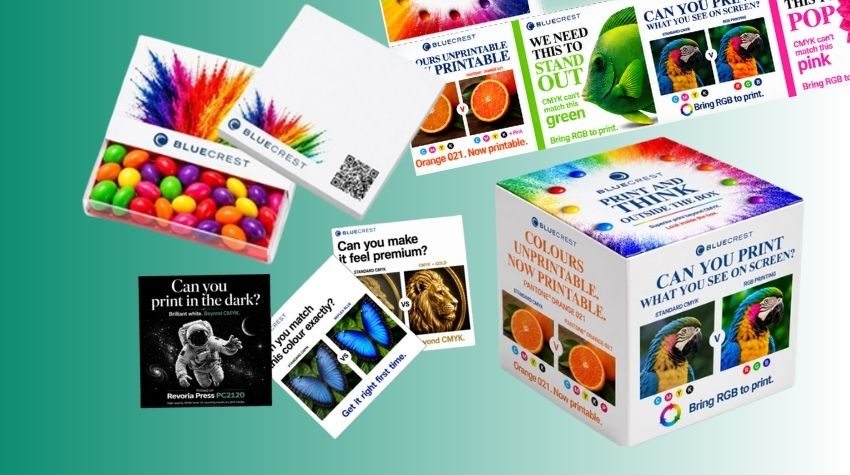
We produced an actual box, with different panels designed to demonstrate what could be achieved beyond standard CMYK. Rather than filling it with lots of marketing copy, the print itself could do much of the talking.
The panels included examples designed around challenging colours and effects such as Reflex Blue, Orange 021, metallic gold and vibrant colours that you would normally associate more with RGB on a screen.
What Went Inside the Box?
Inside were additional printed samples and a few branded items, with a QR code taking recipients directly to a dedicated Fujifilm Revoria Press PC2120 landing page.
The three individual print samples gave us another opportunity to showcase what the Revoria Press PC2120 could do. Each one demonstrated a different print capability, so recipients weren’t just reading about the press. They could actually pick up the samples, look at the colours and see the results for themselves.
We also wanted the contents of the box to tie back to the colour theme and make the mailer a little more memorable. The branded Skittles did exactly that. They added another splash of colour when the box was opened and gave the mailer something unexpected without taking away from the main message.
The branded sticky notes were designed with coloured bands to continue the same theme but they also gave us something useful that could stay on someone’s desk. That meant the BlueCrest name had the potential to remain visible long after the box had been opened.
The idea was that everything inside had a reason for being there. The print samples showcased more of the Revoria’s capabilities, while the Skittles and sticky notes reinforced the colour theme and helped make the overall mailer more memorable.
It meant someone could receive the box, look at the print, handle the samples and then go straight online if they wanted more information.
For me, that was far more powerful than simply sending another email telling printers how good the colour was.
The Data Was Just as Important as the Box
A direct mail campaign like this only makes sense if it reaches the right people.
We weren’t trying to build the biggest mailing list possible. Quite the opposite.
Every box had a cost attached to it. There was the print, the contents, fulfilment and postage, so sending hundreds or thousands of them to people with little chance of being interested would have defeated the whole point.
We worked with Printweek to source targeted industry data and spent a lot of time refining exactly who we wanted to reach.
That meant looking at the type of business rather than simply buying a generic print industry database. We concentrated on relevant commercial printers and mailing businesses and then looked at the people within those companies who were likely to have some involvement in decisions around production equipment and technology.
Printweek was a logical place to source the data because its readership is specifically within the print sector. According to Printweek’s information about its readership, it reaches printing professionals across SMEs as well as some of the UK’s largest printing companies.
The number of contacts was relatively small at around 300, but that was deliberate.
For this type of B2B direct mail campaign, I would much rather spend the budget reaching 300 carefully selected people with something worth looking at than send a cheaper piece to thousands of people simply to achieve a bigger mailing number.
Direct Mail Was Only One Part of the Campaign
Although the box was the physical centrepiece, the wider campaign wasn’t purely direct mail.
We used Printweek advertising to build visibility within the same market, alongside email campaigns, LinkedIn content and dedicated landing pages. The QR code on the mailer connected the physical piece directly to the digital campaign, so someone interested in what they had received could immediately find out more online.
The timing was important too. The boxes were sent out ahead of The Print Show at the NEC Birmingham from 29 September to 1 October, where Fujifilm will be showcasing the Revoria Press PC2120. It meant the campaign could put the press in front of our audience before they had the opportunity to see it for themselves at the show.
You can read more about Fujifilm at The Print Show 2026
That’s probably one of the biggest differences between using direct mail now and the campaigns I worked on years ago.
It doesn’t need to operate on its own.
Digital marketing can support the campaign before the mailer arrives, reinforce the message afterwards and provide somewhere for the recipient to take the next step.
I talk about this wider approach in What Does a Digital Marketing Person Actually Do?. Good marketing rarely comes down to doing one thing. It’s usually a combination of content, email, social media, advertising, website activity and whatever else makes sense for the audience you’re trying to reach.
In this case, direct mail gave us something digital couldn’t. Digital then gave the physical campaign somewhere to go next.
There Was a Lot More to It Than Designing a Box
One of the things I like about this campaign is that it shows how much work can sit behind what eventually lands on someone’s desk.
There was the initial idea and campaign message, but then came the box design, copy, artwork, printed samples, branded contents, QR code, landing pages, Printweek advertising, email campaigns and LinkedIn activity.
Even the contents needed planning. The printed samples had to showcase the right capabilities, while the Skittles and sticky notes needed to fit the creative idea and branding rather than simply feel like promotional giveaways.
There was also the less glamorous but very important side of direct mail. We had to source and check the data, coordinate the print, order the items, approve proofs and bring everything together for fulfilment and mailing.
It involved working with BlueCrest, Fujifilm, Printweek, the printer, artworker and fulfilment company to make sure all the different parts came together at the right time.
That’s the bit of marketing people don’t always see.
The creative idea matters, but somebody still has to make the whole thing happen.
So Does Direct Mail Still Work?
I think the better question is whether direct mail is right for the campaign you’re planning.
I wouldn’t recommend it simply because inboxes are busy or because receiving something through the post feels different. Those things can help, but they aren’t enough on their own.
For this campaign, there was a clear reason for using it.
The audience was tightly defined. We had access to relevant industry data. The product could be demonstrated through print and the people receiving it were particularly well placed to appreciate what they were looking at.
Most importantly, the marketing asset itself helped prove the marketing message.
In this case that was quite literal. The box they received had been printed on the press we were asking them to consider.
That’s what made direct mail the right choice.
Choosing the Right Marketing Rather Than the Obvious Marketing
I still spend most of my time working on digital marketing and that’s unlikely to change. It’s where businesses need to be and it gives us opportunities to target, measure and adapt campaigns in ways we simply couldn’t do years ago.
But I don’t think good marketing starts by deciding you need an email campaign, a LinkedIn post, a Google Ad or a piece of direct mail.
It starts with the audience and what you’re trying to achieve.
I’ve worked across marketing for more than 20 years and the tools have changed considerably during that time. The principle behind them hasn’t changed nearly as much. You still need to understand who you’re trying to reach, what you want to say and what is most likely to make them pay attention.
That’s also the thinking behind Hats Off Digital Marketing. I work across content, social media, email, advertising, websites and campaign creative rather than trying to make every marketing problem fit the same channel.
For BlueCrest and this particular print industry campaign, the answer happened to be a very physical one.
A box, printed on the product we were promoting, sent to a carefully selected group of people who would understand exactly what they were looking at.
Sometimes that’s simply the right marketing.